Know
these concepts, follow these admonitions, and (a) you’ll do well in the course;
and (b) may be empowered for life (acc. G. Atwood).
Coaching...
bookmark this page, even print it off, so you can
refer to it during lectures, while you do homework, and... especially
for exams. There are four sections on this page:
A.
Geography Is...
B.
The 15 Themes of Geog3600 – Geography of
C.
Think Like a Geographer of Utah means… (a) introduce the issue; (b) gather evidence; (c) observe patterns and connections; (d) analyze/discuss in the context of Big Concepts; (e) evaluate and articulate importance based on impacts to diverse of the 15 themes.
D.
LINKS to
Geography is:
“Geography is the science of space and place
on Earth’s surface. Its subject matter is the physical and human phenomena that
make up the world’s environments and places. Geography asks us to look at the
world as a whole, to understand connections between places, to recognize that
the local affects the global and vice versa. The power and beauty of geography lies
in seeing, understanding, and appreciating the web of relationships among
people, places and environments.”
According to National Geographic… standards…
B. THE 15 Themes
of Geog3600 -- when
you (a) understand these themes; (b) appreciate their spatial distributions
across
The FIVE Great Themes of Geography:
1-
Location
2-
Place
3-
Interaction
4-
Movement also
called migration
5-
Regions
FIVE ISSUES of SOCIAL and BEHAVIORAL SCIENCE to
explore all semester long: :
6- Anthropology …
specifically
7- Economics …
distributions of wealth
8- Demographics … distributions of
9- Political
Science
… issues of power, partisan politics and government
10- Sociology … social institutions
including religions.
The
FIVE subsystems of Earth systems = PHYSICAL GEOGRAPHY.
11-
Geosphere =
the solid Earth. The geosphere largely determines topography; resources; geologic
hazards; and scenery.
12- Hydrosphere = water Earth. The
hydrosphere largely determines water supplies; water-related hazards including
pollution; and waste disposal / isolation.
13- Atmosphere = gaseous Earth. The
atmosphere largely determines weather; climate; quality of life such as
recreation; natural hazards of air pollution; weather-related hazards including
severe snows, climate change, heat waves; and critical component of water
balance.
14- Biosphere = living Earth. The
biosphere contributes to the balance among Earth’s modulating systems; globally
it determines food sources; it is our niche (where we live, and what we eat).
15- Anthrosphere = the portion of Earth
dominated by human activities, sometimes called the
human footprint and includes direct impacts and indirect impacts.
C. What
is meant by "THINK LIKE A GEOGRAPHER?"
Answer
exam questions, create short reports (such as Atlas
chapters or field reviews) in four steps:
FIRST
SECTION – EVIDENCE -- gather evidence… be evidence driven
SECOND
SECTION– OBSERVATIONS – observe spatial patterns, see the obvious, don’t
confuse observation and interpretation.
THIRD SECTION– DISCUSSION - Think about what you're supposed to know,
Analyze in the context of Big Concepts. Do more than “wing it”… think critically
(examples, explore definitions, explain nuances, dig deeper into concepts
FOURTH SECTION– IMPORTANCE – Explain why the issue / theme / topic
matters by pointing out causal relationships with others of the 15 Themes of
Geog3600.
If something impacts those themes… it’s important.
D. LINKS
to useful maps...
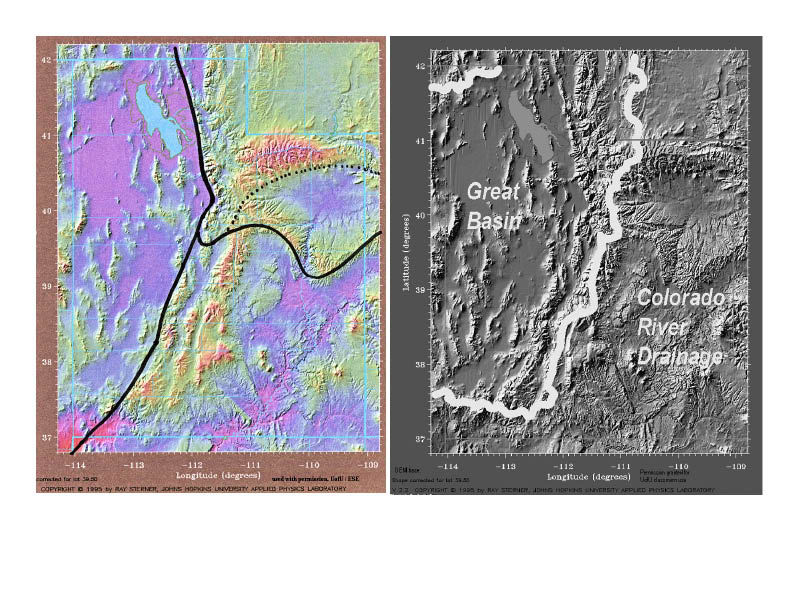
GEOSPHERE
- physiographic provinces LINK
and LINK
HYDROSPHERE
- drainage basins LINK
contrast hydro - geo LINK
ATMOSPHERE
- climate zones LINK
BIOSPHERE
- bioregions LINK
ANTHROSPHERE
- counties LINK and counties with names simplified on UGS base LINK; and Utah's State Highway Map LINK